Doing Good to All People: Amish Relief and Development Ministries
DOI:
https://doi.org/10.18061/jpac.v5i1.10258Keywords:
Amish agency, relief, development, Gelassenheit, Amish entrepreneurs, Mennonite Central Committee, Mennonite Disaster Service, Storm Aid, Plain Community Agricultural Exchange, Horse Progress DaysAbstract
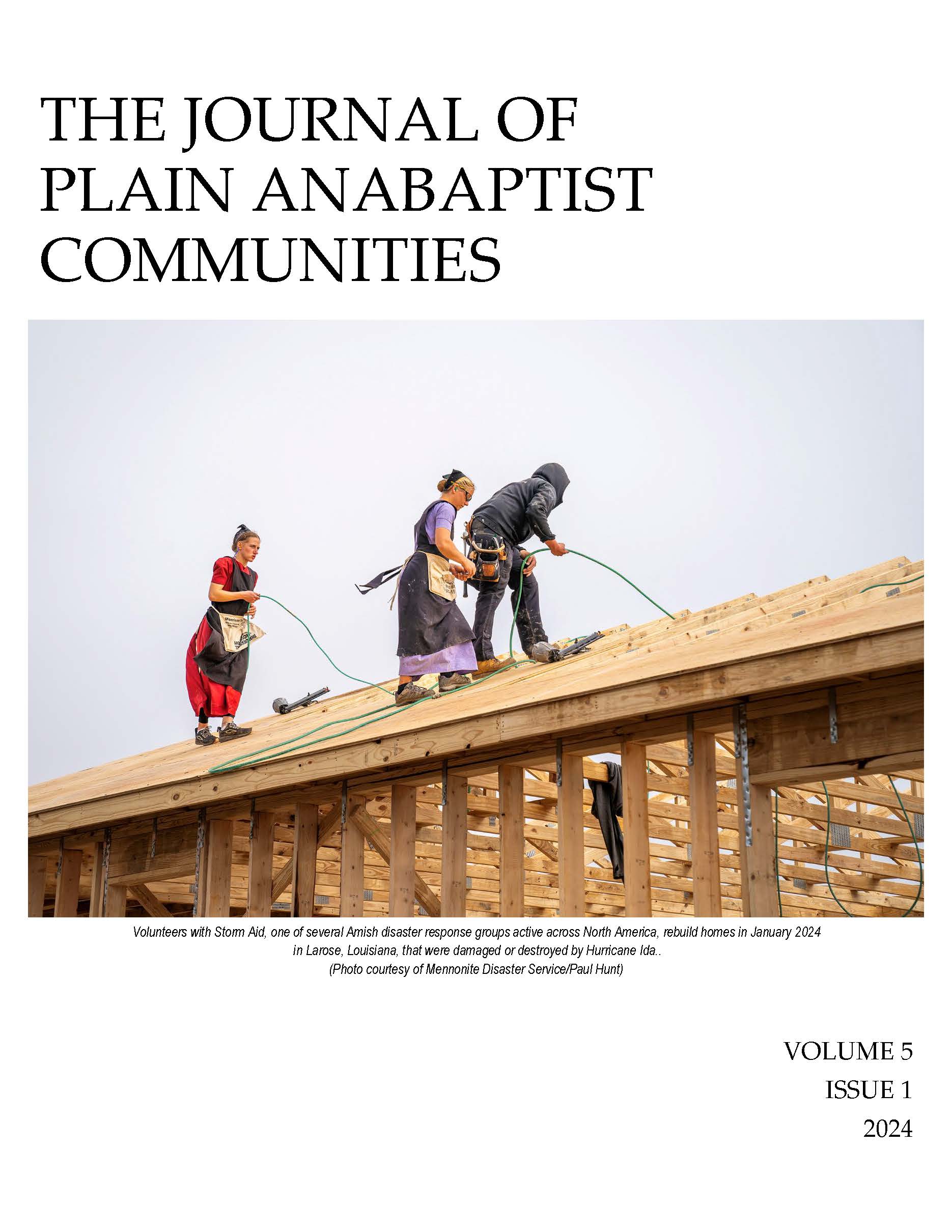
The Old Order Amish church is experiencing a vibrant new chapter in its American experience as it gains agency in the areas of Christian relief and development ministries. Scholars have described the energetic and highly successful entrepreneurial spirit among the Amish over the past decades. This paper documents how the Amish are building on their success as sophisticated business leaders in creating Christian relief and development ministries. The Amish community has leveraged the lessons learned as entrepreneurs toward nonprofit ministries serving people well beyond their own Anabaptist communities. Three case studies—Gifts for Relief and White Horse Relief Center, Mennonite Disaster Service and Amish Storm Aid, and Plain Community Agricultural Exchange—serve as examples of the nascent Amish agency of doing good deeds for people beyond their own Anabaptist communities and of Amish conceptualizing and actualizing Christian relief and development ministries. These three ministries are only the beginning of what likely will be many more Amish-led relief and development ministries. The paper also notes that non-Amish relief and development ministries who seek to partner with the Amish will need to move from an often-paternalistic relationship to a peer-to-peer partnership with the Amish.
Downloads
Published
Issue
Section
License
Copyright (c) 2024 Joseph S. Miller

This work is licensed under a Creative Commons Attribution-NonCommercial-NoDerivatives 4.0 International License.
This Author Agreement for The Journal of Plain Anabaptist Communities ("Agreement") is entered into by and between The Ohio State University, on behalf of its University Libraries ("Publisher") and the author ("Author").
For good and valuable consideration, Publisher and Author agree as follows:
1. Author hereby grants to Publisher the right to publish, reproduce, distribute, translate, transmit and display his/her submitted work and an abstract thereof ("Work") in The Journal of Plain Anabaptist Communities in whole or in part and in all formats and all media. Author also hereby grants to Publisher the right for Publisher to enter into agreements with third parties that grant such third parties any or all of the rights that Author has granted to Publisher herein. The aforementioned rights may include the rights necessary to index and abstract the Work. The Author agrees that any subsequent publication of the Work will credit The Journal of Plain Anabaptist Communities as the site of first publication and provide a link to The Journal of Plain Anabaptist Communities website. This Agreement is subject to the terms and expectations outlined on Publisher's website (http://go.osu.edu/publishing-services).
2. Author represents and warrants that: (1) they are the creator and rights holder of the Work; (2) Publisher's exercise of the rights granted to Publisher herein will not infringe or violate any copyright or any other right of a third party; (3) if the Work contains any third party content, they have obtained the unrestricted permission of the copyright owner or that use of third party material is allowed because the material is in the public domain or an appropriate fair use analysis has been performed and there is a reasonable belief that use is permitted and (4) the Work contains nothing libelous or otherwise unlawful. Author hereby agrees to indemnify and hold harmless Publisher and its trustees, officers, employees, agents, and subgrantees from all claims related to Publisher's exercise of the rights granted to Publisher herein or related to the subject matter covered in Author's representations and warranties.
The Journal of Plain Anabaptist Communities is published under a Creative Commons Attribution-NonCommercial-NoDerivatives 4.0 International license, to allow for certain types of reuse without permission. By submitting this agreement, the Author agrees to apply a CC BY-NC-ND 4.0 license to the Work upon publication.